

Capture-Mark-Recapture Sampling
A common way to estimate wildlife population

How many fish are there in a lake? If it is a big lake with many fish, then it would be impractical to count them one by one. Thankfully, there is a sampling technique that can obtain a fairly decent approximation.
Capture-mark-recapture (CMR) is a method for estimating the population size of wildlife in a particular habitat. It involves
1) capturing a sample of individuals from a population in a standardized time period,
2) marking them in a harmless way,
3) releasing them back into their habitat,
4) allowing some time for the marked individuals to mix back into the population,
5) capturing a second sample in the same standardized time period.
The diagram below illustrates the relevant quantities.
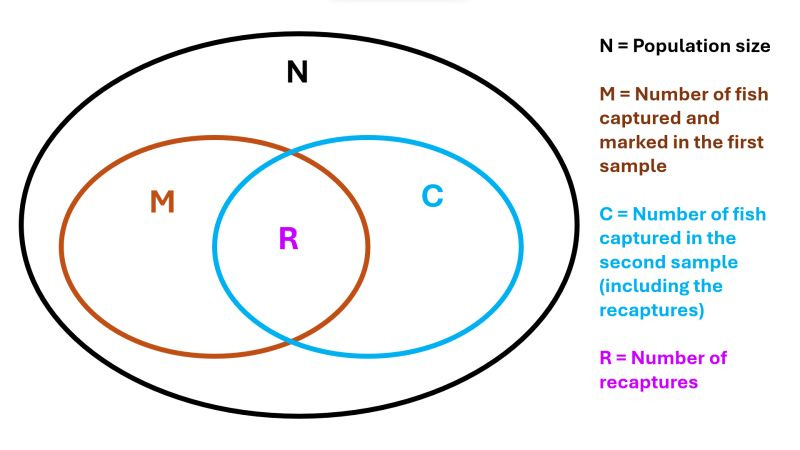
Here is the basic idea behind the estimation process: If a certain proportion, P, of the population was marked in the first capture, the same proportion should be marked in the second capture. This leads to an equation between the 2 proportions.
Let
M = number of fish captured and MARKED in the first sample,
C = number of fish captured in the second sample,
R = number of marked fish recaptured in the second sample,
N = total number of fish in the lake (unknown and to be estimated).
Following our assumption,
By algebraically re-arranging the terms in this equation, you can obtain the total number of fish in the lake. This leads to the Lincoln-Petersen estimator, a common formula used in CMR studies. It estimates the population size N as:
CMR is a valuable technique in ecology for studying populations that are difficult to count directly, such as fish, birds, or mammals. It provides insights into population dynamics, survival rates, and movement patterns, aiding in conservation and management efforts.
CMR relies on several assumptions; I will discuss them in a future post. Please stay tuned!
To learn more about capture-mark-recapture, please read the relevant article from Wikipedia.