

Permanent Daylight Saving Time in British Columbia
Beware of discrepancies with American jurisdictions on the Pacific coast.

The Canadian province of British Columbia (BC) is permanently adopting Daylight Saving Time. (BC is Canada’s westernmost province. Major cities in BC include Vancouver, Victoria, Kelowna, Kamloops, and Prince George.) Here are the details from the Government of BC:
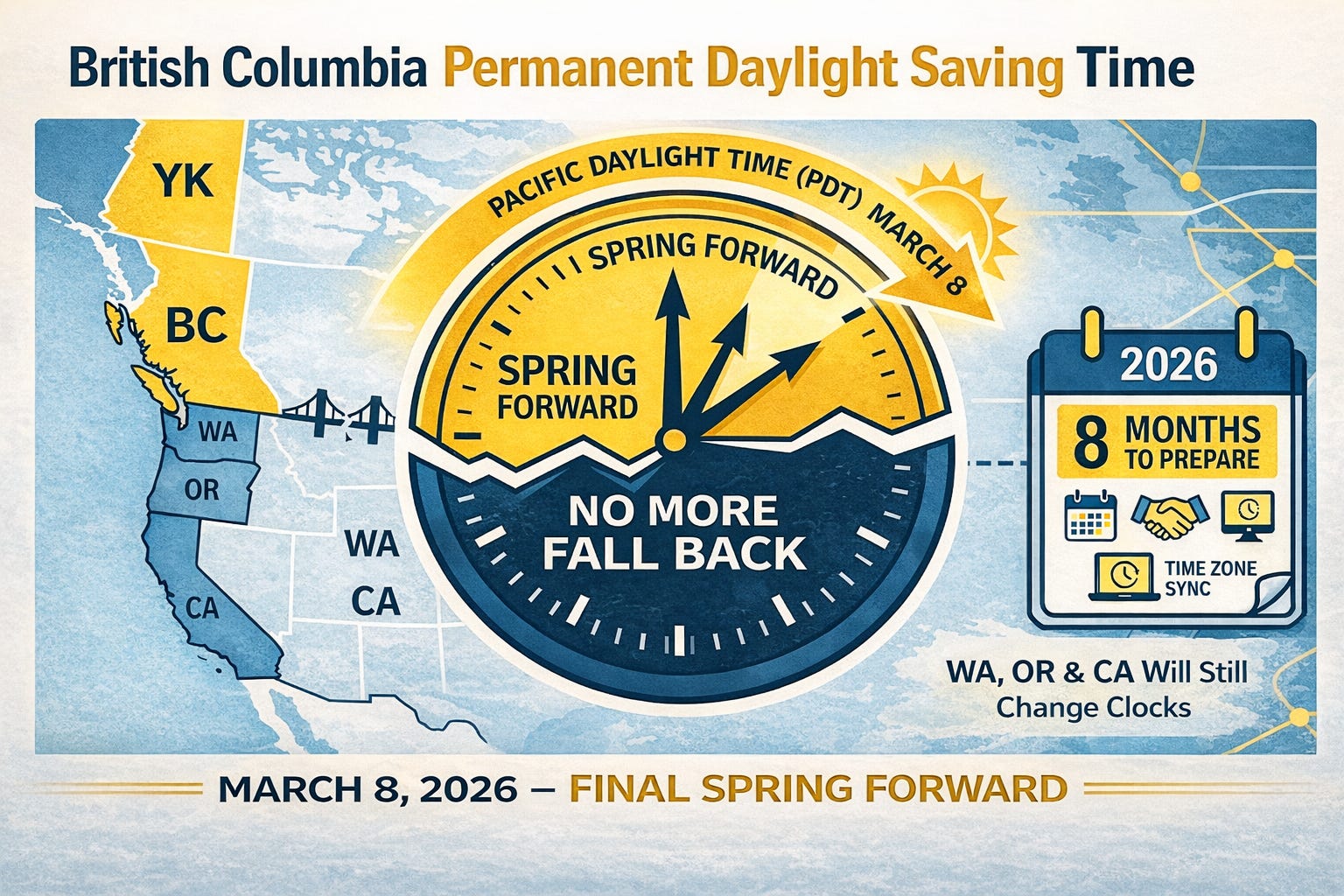
The transition to one year-round time zone will begin after the province “springs forward” on Sunday, March 8, 2026, when clocks move ahead by one hour. This will be the final time change in British Columbia. People and businesses will have eight months to prepare for Nov. 1, 2026, when clocks would usually be turned back, but now will remain the same. At that point, the transition to Pacific time, the name of BC’s new time zone, will be complete.
For the majority of people in BC there are no immediate actions. Many clocks will automatically “spring forward” an hour as usual on Sunday, March 8, 2026. On Nov. 1, 2026, when previously clocks would have been turned back an hour, no change will be made, and the adjustment will not be required.
In the past, BC aligned any changes to Daylight Saving Time with American states in the Pacific Time Zone - but not with this new change. Washington, Oregon, and California have not yet adopted permanent Daylight Saving Time. Thus, if you conduct business between BC and these western American states regularly, you need to be carefully aware of this discrepancy.
The Canadian territory of Yukon is north of British Columbia, and it adopted permanent daylight saving time in 2020. Moving forward, BC and Yukon will be aligned in terms of time throughout each year.
I prefer to let computers and online calendars convert between time zones whenever possible. This is especially helpful when one region uses Daylight Saving Time and another region does not. To avoid headaches and unintentional mistakes, I don’t write “Eastern Standard Time” when I coordinate meetings, and I just write “Eastern Time” instead.
To learn the full details, please read the Government of British Columbia’s website.